Calories in Nougat: Nutritional facts for Nougat Types
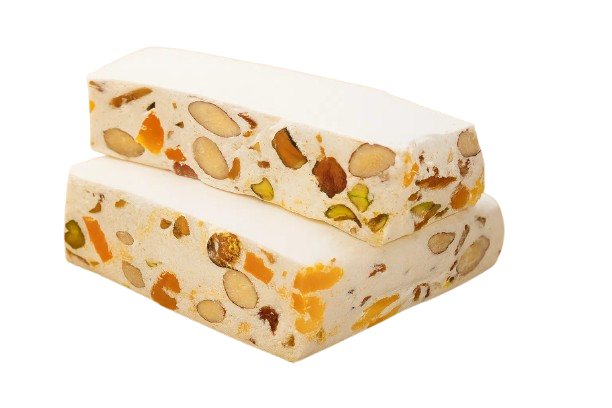
Nougat is a high calorie confection made from sugar, honey, roasted nuts, and whipped egg whites. A small bar (14g) has 56 nougat calories, a medium nougat bar (34g) contains 135 calories, and a large bar (85g) provides 338 calories. Commercial products vary, with a Ferrara Torrone bar (43g) having 180 calories while a 3 Musketeers bar (54.4g) contains 240 calories. A standard 100g portion of nougat with almonds contains 398 calories.
The nougat nutrition facts show a food composed almost entirely of carbohydrates, as a medium bar (34g) provides 1.1g of protein, 0.6g of fat, and 31.4g of carbohydrates, including 15.3g of sugar. The preparation style dramatically alters the calorie content, with a classic white nougat containing 398 calories per 100g, while a German-style chocolate-hazelnut nougat can have 550 calories per 100g. A key health benefit comes from the nuts, which provide healthy fats, though the amount is small, with a 100g serving containing just 1.7g of fat. A study by Guasch-Ferré, M., et al. (2017) found that higher nut consumption was associated with a lower risk of cardiovascular disease.
Nougat’s global availability relies on top almond producers like the United States and Spain, and major confectionery consumers such as Germany. Its versatility is seen in its use as a component in at least five different candy bars and desserts and as a specialty in five distinct European and Middle Eastern cuisines. This global demand and the rising costs of sugar and nuts are reflected in the price, with a specialty bar increasing from under $3.00 in the early 2000s to over $5.00 after 2020.
Nougat is considered fattening due to its high energy density and low satiety, meaning regular consumption can lead to weight gain. Dietary guidelines from organizations like the American Heart Association recommend limiting such foods, and a single medium nougat bar with over 15g of sugar represents a large portion of the daily recommended limit. The 56 calories in a small 14g piece require an energy expenditure equivalent to 6 minutes of running or 7 minutes of swimming.
Nougat nutrition
- Large Nougat Calories (Nutritional Facts)
- Medium Nougat Calories (Nutritional Facts)
- Small Nougat Calories (Nutritional Facts)
- Raw Nougat Nutrition
- Sodium in Nougat
- Potassium in Nougat
- Sugar in Nougat
- Fiber in Nougat
- Protein in Nougat
- Carbs in Nougat
- Fat in Nougat
- Vitamins in Nougat
- Minerals in Nougat
Large Nougat Calories (Nutritional Facts)
A large nougat bar (85g or 3oz) contains 338 calories, 2.8g of protein, 1.4g of fat, 78.5g of carbohydrates, 2.8g of fiber, 38.3g of sugar, and 28mg of sodium.
A medium nougat bar (34g or 1.2oz) provides 135 calories, 1.1g of protein, 0.6g of fat, 31.4g of carbohydrates, 1.1g of fiber, 15.3g of sugar, and 11mg of sodium.
A small nougat bar (14g or 0.5oz) contains 56 calories, 0.5g of protein, 0.2g of fat, 12.9g of carbohydrates, 0.5g of fiber, 6.3g of sugar, and 5mg of sodium.
Nougat is a confection that is not eaten raw. All nutritional values are for the final cooked product of heated sugar, honey, nuts, and egg whites.
A large nougat bar (85g) contains 28mg of sodium (1% DV). A medium bar (34g) has 11mg of sodium (0% DV). A small bar (14g) contains 5mg of sodium (0% DV).
A large nougat bar (85g) contains 89mg of potassium (2% DV). A medium bar (34g) has 36mg of potassium (1% DV). A small bar (14g) contains 15mg of potassium (0% DV).
A large nougat bar (85g) contains 38.3g of sugar. A medium bar (34g) has 15.3g of sugar. A small bar (14g) contains 6.3g of sugar.
A large nougat bar (85g) provides 2.8g of dietary fiber (10% DV). A medium bar (34g) has 1.1g of fiber (4% DV). A small bar (14g) contains 0.5g of fiber (2% DV).
A large nougat bar (85g) provides 2.8g of protein (6% DV). A medium bar (34g) has 1.1g of protein (2% DV). A small bar (14g) contains 0.5g of protein (1% DV).
A large nougat bar (85g) contains 78.5g of carbohydrates (29% DV). A medium bar (34g) has 31.4g of carbohydrates (11% DV). A small bar (14g) contains 12.9g of carbohydrates (5% DV).
A large nougat bar (85g) contains 1.4g of total fat (2% DV). A medium bar (34g) has 0.6g of total fat (1% DV). A small bar (14g) contains 0.2g of total fat (0% DV).
A large nougat bar (85g) provides 0.3mg of Vitamin C (0% DV) and 2.4mg of Vitamin E (16% DV). A medium bar (34g) provides 0.1mg of Vitamin C (0% DV) and 0.9mg of Vitamin E (6% DV). A small bar (14g) provides 0.04mg of Vitamin C (0% DV) and 0.4mg of Vitamin E (3% DV).
A large nougat bar (85g) provides 0.5mg of iron (3% DV) and 27mg of calcium (2% DV). A medium bar (34g) provides 0.2mg of iron (1% DV) and 11mg of calcium (1% DV). A small bar (14g) provides 0.1mg of iron (1% DV) and 4mg of calcium (0% DV).
Get a Custom Report on Nougat Nutrition Data – Contact Us!
What are the Types of Nougats?
The types of nougats are White Nougat, Brown Nougat, and German Nougat. These variations are distinguished by their ingredients and method of preparation, which results in different colors, textures, and flavors. A guide to these common nougat styles is in the table below.
| Type | Description | Calories (Approximate per 100g) | Calorie Qualifications |
|---|---|---|---|
|
White Nougat (Nougat de Montélimar)
|
The most common type, made with whipped egg whites, sugar, and honey. Soft and chewy, with nuts like almonds or pistachios. | 398 | This is the standard version, with calories coming primarily from sugar, honey, and nuts. |
|
Brown Nougat (Nougatine)
|
Made without egg whites, using caramelized sugar and nuts. Hard, brittle, and crunchy. | 520 | The high concentration of caramelized sugar and nuts makes this version more calorie-dense. |
|
German Nougat (Viennese Nougat)
|
A confection made from chocolate, sugar, and nuts (usually hazelnut). Soft and praline-like, not a traditional nougat. | 550 | The high fat content from chocolate and hazelnuts makes this the most calorie-dense version. |
What are Desserts with Nougat?
Nougat is a standalone confection but is also used as an ingredient or component in other desserts. A catalog of items that incorporate nougat is detailed in the table below.
| Dish Name | Calories (Estimate per serving) | Type of Dessert | Carbs (g) (Estimate) | Sugar (g) (Estimate) | Protein (g) (Estimate) | Fat (g) (Estimate) | Cuisine | Restaurants |
|---|---|---|---|---|---|---|---|---|
|
Toblerone (Chocolate Bar)
|
170 (per 33g) | Confection | 20 | 20 | 2 | 9 | Swiss | Toblerone (retail) |
|
3 Musketeers (Candy Bar)
|
240 (per 54g) | Confection | 42 | 36 | 1 | 7 | American | Mars, Inc. (retail) |
|
Snickers (Candy Bar)
|
250 (per 52g) | Confection | 33 | 27 | 4 | 12 | American | Mars, Inc. (retail) |
|
Torrone
|
180 (per 43g) | Confection | 29 | 24 | 2 | 6 | Italian | Ferrara (retail) |
|
Semifreddo al Torrone
|
300 (per slice) | Frozen Dessert | 30 | 28 | 6 | 18 | Italian | Eataly |
What Cuisines Prefer Nougat the Most?
Nougat is a classic confection with deep roots in Southern European and Middle Eastern cuisines. The following list displays the culinary traditions where nougat is a celebrated specialty.
| Cuisine | Dish | Types of Nougats Used | Calories (Estimate) | Brand(s) |
|---|---|---|---|---|
|
French
|
Nougat de Montélimar | White nougat with almonds and pistachios | 400-450 | Chabert & Guillot (retail) |
|
Italian
|
Torrone | White nougat, often with almonds or hazelnuts | 400-450 | Ferrara, Perugina (retail) |
|
Spanish
|
Turrón | White (blando) or Brown (duro) nougat | 450-550 | 1880, El Almendro (retail) |
|
Middle Eastern
|
Gaz | White nougat with pistachios and rosewater | 400-450 | Sadaf (retail) |
|
German/Austrian
|
Wiener Nougat | Chocolate-hazelnut praline-style nougat | 550-600 | Milka (retail) |
Which Countries Produce the Most Nougat?
The top producers of almonds, the key ingredient in traditional nougat, are the United States, Spain, and Australia. Specific global production data for finished nougat is not tracked as a separate category. The table below shows the production quantity of almonds (with shell) in key countries.
| Country | 2003 | 2008 | 2013 | 2018 | 2019 | 2020 | 2021 | 2022 |
|---|---|---|---|---|---|---|---|---|
| United States | 1,043,000 | 1,451,000 | 1,814,000 | 2,268,000 | 2,536,000 | 3,084,000 | 2,812,000 | 2,617,000 |
| Spain | 130,000 | 220,000 | 215,000 | 339,000 | 340,000 | 350,000 | 407,000 | 320,000 |
| Australia | 70,000 | 110,000 | 150,000 | 180,000 | 221,000 | 230,000 | 270,000 | 280,000 |
| Turkey | 45,000 | 55,000 | 80,000 | 100,000 | 150,000 | 160,000 | 170,000 | 180,000 |
| Morocco | 50,000 | 80,000 | 110,000 | 115,000 | 120,000 | 130,000 | 135,000 | 140,000 |
Which Countries Consume the Most Nougat?
The top consumers of confectionery, a category that includes nougat, are found in Europe and North America. Consumption data for nougat is best represented by import values for the broader category of "sugar confectionery." The table below shows import values for this category in key markets.
| Country | 2003 | 2008 | 2013 | 2018 | 2019 | 2020 | 2021 | 2022 |
|---|---|---|---|---|---|---|---|---|
| United States | 1,500,000 | 2,200,000 | 2,800,000 | 3,500,000 | 3,700,000 | 3,900,000 | 4,500,000 | 5,100,000 |
| Germany | 1,200,000 | 1,800,000 | 2,400,000 | 2,900,000 | 3,000,000 | 3,100,000 | 3,500,000 | 3,800,000 |
| United Kingdom | 1,100,000 | 1,600,000 | 2,100,000 | 2,600,000 | 2,700,000 | 2,800,000 | 3,100,000 | 3,400,000 |
| France | 800,000 | 1,200,000 | 1,600,000 | 2,000,000 | 2,100,000 | 2,200,000 | 2,500,000 | 2,700,000 |
| Netherlands | 600,000 | 950,000 | 1,300,000 | 1,700,000 | 1,800,000 | 1,900,000 | 2,200,000 | 2,400,000 |
How Do Prices of Nougat-Including Dishes Change?
The retail cost of candy bars featuring nougat has risen over the past ten years, an increase caused directly by higher prices for wholesale ingredients and elevated expenses for production and shipping. This upward price trend is evident in the cost of popular candy bars.
| Brand | Dish | Old Price (Year) | Current Price (2024/2025) |
|---|---|---|---|
| Mars, Inc. | 3 Musketeers (Standard Bar) | $0.99 (2014) | $1.79 - $3.29 |
| Mars, Inc. | Snickers (Standard Bar) | $0.99 (2014) | $1.69 - $2.29 |
| Mondelēz International | Toblerone (100g Bar) | $1.99 (2015) | $2.99 - $3.99 |
| Ferrara Candy Company | Torrone Bar | $1.29 (2016) | $1.99 - $3.29 |
What is the Nougat Calorie for 100 Grams?
A 100g serving of nougat with almonds contains 398 calories.
What is the Nougat Calorie for 1 KG?
One kilogram (1000g) of nougat with almonds contains 3,980 calories.
What is the Calorie of 1 Nougat?
A single piece of nougat (14g) contains 56 calories, while commercial bars vary, with a Ferrara Torrone bar (43g) having 180 calories and a 3 Musketeers bar (54.4g) containing 240 calories.
What are the Health Benefits of Nougat?
The nutritional upsides of nougat are minimal and are mainly derived from the nuts and egg whites. A summary of these limited potential advantages is available here.
- Contains Healthy Fats from Nuts: Nougat made with almonds or other nuts provides monounsaturated and polyunsaturated fats, which are beneficial for heart health. A study by Guasch-Ferré, M., et al. (2017), "Nut Consumption and Risk of Cardiovascular Disease," found that higher nut consumption was associated with a lower risk of cardiovascular disease.
- Provides a Source of Protein: The combination of egg whites and nuts offers a modest amount of protein, which is essential for building and repairing tissues in the body. A medium nougat bar (34g) contains 1.1g of protein.
- Supplies Some Minerals: The nuts in nougat contribute small amounts of essential minerals like magnesium and copper, which are important for nerve function and energy production. A large nougat bar (85g) can provide 7% of the Daily Value for magnesium.
What are the Downsides of Nougat?
The confection's composition presents several health liabilities, primarily due to its main ingredient. An overview of these health risks is presented here.
- Extremely High in Sugar: Nougat is predominantly made of sugar and honey, which can cause a rapid and significant spike in blood glucose levels. A scientific statement from the American Heart Association by Johnson, R. K., et al. (2009), "Dietary sugars intake and cardiovascular health," recommends strict limits on added sugar, linking high consumption to an increased risk of obesity, type 2 diabetes, and heart disease. A healthier alternative is a small handful of plain almonds. A suggested amount is to limit consumption to one small bar on a rare occasion.
- High Calorie Density: Nougat is a very energy-dense food, meaning a small portion contains a large number of calories with very few micronutrients. A review by Popkin, B. M., et al. (2012), "Global nutrition transition and the pandemic of obesity in developing countries," discusses how a shift toward energy-dense, nutrient-poor foods is a major driver of the global obesity epidemic.
Are Nougats Good for You?
No, nougats are not good for a person because the confection is almost entirely sugar, and any minor benefits from nuts or egg whites are completely negated by the massive sugar content. The impact on metabolic health is negative. The high concentration of simple sugars can overwhelm the body's ability to regulate blood glucose, promoting insulin resistance over time. A review by Stanhope, K. L. (2016), "Sugar consumption, metabolic disease and obesity: The state of the controversy," details how excessive sugar intake is a key driver of metabolic syndrome. For dental health, the sticky, sugary nature of nougat is particularly detrimental, as it adheres to teeth and increases the risk of cavities. A study by Touger-Decker, R., & van Loveren, C. (2003), "Sugars and dental caries," affirms the direct relationship between the frequency of sugar consumption and the risk of developing dental caries. For liver health, the high sugar content can be converted into fat by the liver, contributing to non-alcoholic fatty liver disease. A review by Tappy, L., & Lê, K. A. (2010), "Metabolic effects of fructose and the worldwide increase in obesity," explains this metabolic pathway.
Is Nougat Healthy?
No, nougat is not a healthy food. The confection is composed almost entirely of sugar and lacks significant amounts of beneficial nutrients like vitamins, minerals, and fiber. Such foods are considered sources of "empty calories" and can contribute to nutrient deficiencies if they displace more wholesome foods from the diet. A review by Popkin, B. M., et al. (2012), "Global nutrition transition and the pandemic of obesity in developing countries," discusses how a shift toward energy-dense, nutrient-poor foods is a major driver of the global obesity epidemic. The high sugar content is the primary health concern. A meta-analysis by Malik, V. S., et al. (2006), "Intake of sugar-sweetened beverages and weight gain: a systematic review," found clear evidence linking the consumption of sugary items to weight gain. The lack of fiber and protein also makes nougat a poor choice for satiety. A study by Holt, S. H., et al. (1995), "A satiety index of common foods," found that confectionery items like candy bars were among the least filling foods tested per calorie. A suggested consumption rate is to treat nougat as a rare indulgence, limiting intake to one small piece (14g) to manage sugar intake.
Is Nougat Fattening?
Yes, nougat is fattening. The confection is exceptionally high in calories from sugar packed into a small, dense serving, making the food extremely energy-dense. Consuming more calories than the body expends leads to weight gain. A study by Pérez-Escamilla, R., et al. (2012), "Dietary energy density and body weight in adults and children: a systematic review," found a positive association between dietary energy density and body weight. The large amount of sugar in nougat promotes fat storage in the body. The liver can convert excess sugar into fat through a process called de novo lipogenesis. A review by Tappy, L., & Lê, K. A. (2010), "Metabolic effects of fructose and the worldwide increase in obesity," explains the metabolic pathways through which excess dietary sugar can lead to fat accumulation. The high sugar content is also highly palatable and not very filling, which can lead to overeating. A study by Holt, S. H., et al. (1995), "A satiety index of common foods," found that candy bars were among the least satiating foods tested per calorie. A suggested consumption rate is to limit intake to a single small piece (14g) on an infrequent basis.
How Do Calories Change According to Nougat Types?
The ingredients and preparation method dictate the calorie count of nougat. German nougat has the highest calorie value at 550 calories per 100 grams, a consequence of its high-fat chocolate and hazelnut base. A classic white nougat contains the lowest calorie value at 398 calories per 100 grams, a reflection of its simpler, lower-fat composition of egg whites, sugar, and honey. Brown nougat, or nougatine, falls in between but is still very high in calories due to the density of caramelized sugar.
How Does Nougat Compare to Other Sugary Snacks in Terms of Nutrition?
A classic white nougat is nutritionally similar to many other sugar-based confections, but it can be slightly better or worse depending on the comparison. Compared to a gummy candy, which is almost 100% sugar, a nougat with almonds offers a small amount of protein, fiber, and healthy fats from the nuts. However, compared to a chocolate bar with a high cocoa content, nougat has fewer minerals like iron and magnesium. A 100g serving of nougat has 398 calories and 45g of sugar, while a 100g serving of milk chocolate has around 535 calories and 59g of sugar. Nougat is lower in fat than most chocolate bars but higher in sugar than many cookies.
What are the Main Dishes with Nougat?
Nougat functions solely as a sweet confection and is never served with main courses. The confection's intense sweetness makes nougat incompatible with savory dishes. Nougat is conventionally offered after a meal with coffee, eaten as an independent snack, or presented as a holiday gift.
How Much Does a Serving of Nougat Weigh on Average?
A serving of nougat weighs between 14 and 50 grams on average. The nougat food energy (per 100g serving) is 398 calories. A small piece like those found in a mixed candy box, weighs around 14 grams and contains 56 calories. A medium individually wrapped bar like a Ferrara Torrone, weighs around 43 grams. Larger candy bars that contain nougat, such as a 3 Musketeers bar, weigh over 50 grams. The serving size is small due to the confection's high density of sugar and calories.
What is the Origin of Nougat?
The history of nougat traces back to ancient times, with roots in the Middle East. The name "nougat" comes from the Latin panis nucatus, meaning 'nut bread'. Early versions of the confection, made with honey, nuts, and spices, were present in the Byzantine Empire and across the Arabic world. The recipe is believed to have traveled from the Middle East to Europe via trade routes. By the 15th century, nougat was being produced in Italy and Spain. The modern white nougat, made with whipped egg whites, is most famously associated with Montélimar, France, where the confection has been made since at least the 17th century, benefiting from the region's abundant almond and honey production.